A reading room
A history of Orpheus
He is not a man we can date. He is a figure Greek poets already called ancient — a lyre that could stop a quarrel, a spear, and a death, and still fail at the last step.
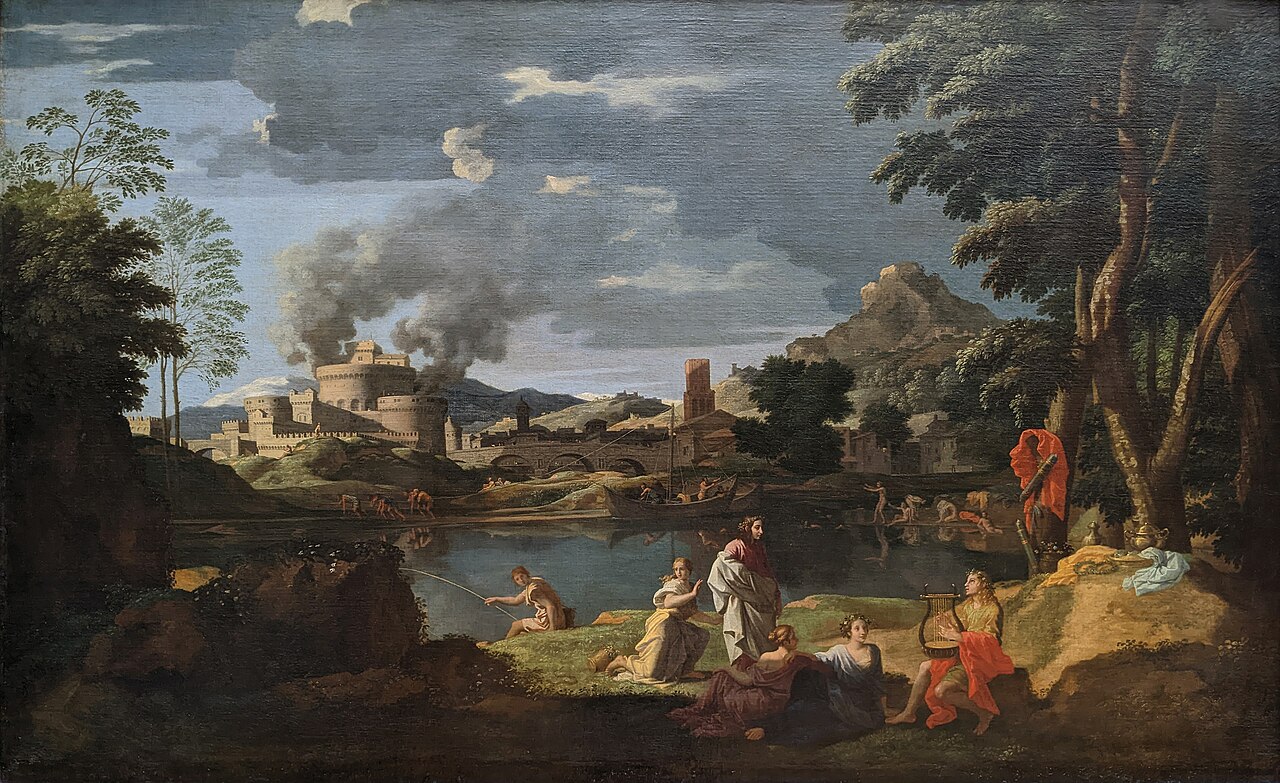
He is the seated figure at the right, still playing. The smoke over the fortress is the omen. Eurydice’s snake is small on purpose: the countryside keeps working, and the catastrophe has already started.
Nicolas Poussin, Landscape with Orpheus and Eurydice, about 1650. Oil on canvas. Musée du Louvre, Paris, INV 7307. Public domain. Source file
What this room will not pretend
There is no birth certificate, no tomb of the man, no decade in which “the historical Orpheus” lived. Greek poets treat him as already ancient. The history is a history of the figure: who told the story, when, what they changed, and what the change was for.
Two underworlds share his name. One is Eurydice. The other is a religious literature — gold leaves buried with the dead, and a burnt commentary on a poem about the gods. They are related by attribution, not by plot. This room keeps them apart.
How the dates are used
- A poet’s century is not the century of the story. Ibycus is early. He is not the origin.
- Virgil writes in 29 BCE. Ovid writes about a generation later, and he changes the causes.
- Premieres are years. Manuscripts are approximate. “About 1330” means the Auchinleck book, not a diary.
- Where two tellings disagree, both stay. Agreement is not the same thing as truth.